Understanding Local Elections

Local elections give eligible voters an opportunity to choose the people who represent their community and make decisions about municipal services, infrastructure, community planning and local priorities.

Whether you're voting for the first time, considering running for Council or curious about what happens behind the scenes, this guide explains how local elections work in Sooke.

Learn about voter eligibility, voting opportunities, how to mark a ballot, the counting process and how official election results are determined.

How Elections Work

General local elections are held every four years in British Columbia, on the third Saturday in October.

In Sooke, eligible voters elect:

  • One Mayor
  • Six Councillors

Together, the Mayor and six Councillors form District Council, which is responsible for making decisions about local government services, policies, budgets and community priorities.

While individual Council members bring their own experiences and perspectives to the role, decisions are made collectively by Council as a governing body.

The most recent General Local Election was held on October 17, 2026. The next general local election is scheduled for October 2030.

Learn more about Mayor and Council.

Yes. School trustee elections generally take place alongside municipal elections, although they are separate from District Council elections.

School trustees serve on the Board of Education and make decisions about public education within their school district.

In Sooke, school trustees are elected to represent the Milnes Landing Zone of School District 62.

If the number of eligible candidates nominated is equal to or fewer than the number of positions available, candidates may be elected by acclamation, meaning no vote is required for those positions.

For example, the three Milnes Landing Zone school trustees were elected by acclamation in 2026 and did not appear on the ballot.

Learn more about School District 62.

A by-election may be held between general local elections to fill a vacancy on Council.

Vacancies can occur for several reasons, including when an elected official resigns, passes away or is otherwise unable to continue serving.

The requirement for a by-election depends on the circumstances and applicable legislation.

Sooke has held several by-elections since incorporation, including a Council by-election in July 2025.

Explore past general elections and by-elections in Sooke.

Who Can Vote in a Sooke Election?

Provincial legislation establishes who is eligible to vote in local government elections.

There are two categories of voters: resident electors and non-resident property electors.

To vote as a resident elector in Sooke, you must:

  • Be 18 years of age or older when registering, or turn 18 by General Voting Day if registering during an election.
  • Be a Canadian citizen.
  • Have lived in British Columbia for at least six months immediately before registering.
  • Live within the District of Sooke when registering.
  • Not be disqualified from voting under provincial legislation or another applicable law.

You do not need to own property to vote.

Renters and homeowners have the same voting rights as resident electors, provided they meet the eligibility requirements.

You also do not need to have lived in Sooke for six months. The six-month residency requirement applies to British Columbia. You must, however, be a resident of Sooke when registering to vote.

You may be eligible to vote in Sooke even if you live elsewhere, provided you meet the requirements for a non-resident property elector.

These requirements include:

  • Being an eligible individual who is a Canadian citizen and meets the applicable age and B.C. residency requirements.
  • Having owned qualifying property within the District of Sooke for at least 30 days before registering.
  • Not being eligible to register as a resident elector in Sooke.
  • Meeting the applicable property ownership and registration requirements.

Only one eligible individual may register as a non-resident property elector for a particular property. Where a property is jointly owned, written consent from a majority of the registered owners, including the person registering, is required.

Corporations are not eligible to vote in local government elections. Owning property through a company does not create a voting entitlement.

Additional documentation is required to confirm eligibility as a non-resident property elector.

Learn more about voter eligibility in British Columbia.

Voter registration arrangements are established for each local election.

Eligible electors may be able to register in advance or at the time of voting, depending on the registration process in place.

When registering to vote, resident electors are generally required to provide two pieces of identification that together establish their identity and place of residence. At least one piece must include a signature.

A photo ID is not necessarily required. If neither piece of identification shows your residential address, you may be able to make a solemn declaration regarding your place of residence.

Electors whose names already appear on the applicable voters list may not be required to show identification, but bringing identification is recommended.

Non-resident property electors must provide additional documentation relating to property ownership and, where applicable, consent from other owners.

Detailed registration instructions and accepted identification requirements will be published before each election.

A Sooke mailing address does not necessarily mean your home is located within the District of Sooke's municipal boundaries.

To vote as a resident elector in a District of Sooke election, you must live within the municipality and meet the other voter eligibility requirements.

Some surrounding communities, including East Sooke, Otter Point, Shirley and Jordan River, are within the Capital Regional District's Juan de Fuca Electoral Area. Eligible residents in these areas vote in regional district elections rather than District of Sooke municipal elections.

If you're unsure which local government area you live in, contact the District before an election. Property owners who live outside municipal boundaries may also qualify to vote as non-resident property electors if they meet the applicable requirements.

When and How Can I Vote?

Local elections provide several ways for eligible electors to participate.

The specific voting opportunities, locations, dates and deadlines are confirmed and published by the District before each election.

General Voting Day is held on the third Saturday in October every four years.

Voting places are open from 8:00 a.m. to 8:00 p.m. on General Voting Day.

Before an election, the District publishes voting locations, accessibility information and instructions for electors.

Advance voting allows eligible electors to cast their ballots before General Voting Day.

You do not need a special reason to vote in advance.

In Sooke, advance voting is offered on multiple dates to provide flexibility for residents with different work schedules, family commitments and other responsibilities.

Voting opportunities are confirmed and advertised before each election.

Mail ballot voting allows eligible electors to vote without attending a voting place in person.

Where mail ballot voting is offered, electors must apply according to the instructions and deadlines established for the election.

A mail ballot package contains instructions for completing and returning the ballot while protecting voter secrecy.

Completed mail ballots must be received by the applicable deadline to be counted. Mailing a ballot before the deadline does not guarantee that it will arrive on time.

Instructions and deadlines are provided for each election.

Special voting opportunities may be established for eligible electors who would otherwise have difficulty attending a regular voting place.

These opportunities may be offered at locations such as assisted-living residences or long-term care facilities.

Special voting is typically restricted to designated eligible electors at the location.

For example, a special voting opportunity was provided for eligible Ayre Manor residents during Sooke's 2026 General Local Election.

The District works to provide accessible voting opportunities so eligible electors can participate.

Depending on individual needs and the voting procedures in place, assistance may include:

  • Curbside voting: For electors who can travel to a voting location but are unable to enter the building or voting area.
  • Assistance marking a ballot: For electors who require help completing their ballot.
  • Translation assistance: For electors who require assistance understanding or communicating election information.

Specific legal procedures, including declarations, apply when another person assists an elector in marking their ballot or providing translation.

Electors are encouraged to contact the District before voting if they have questions about accessibility or require assistance.

Voting assistance is available. Election officials can explain voting procedures without directing or influencing how someone votes.

How to Mark Your Ballot

Every eligible vote is important, and understanding how to mark a ballot helps ensure your selections can be counted accurately.

Sooke uses paper ballots. Where automated vote-counting equipment is used, the equipment scans the ballot and records the selections it can recognize.

The ballot identifies the maximum number of candidates you may vote for in each office.

For example, in a Sooke general local election:

  • Mayor: Select up to one candidate.
  • Councillors: Select up to six candidates.

Other elections or ballot questions may also be included, depending on what is being voted on.

You do not have to select the maximum number of candidates or vote in every contest.

For example, if six Councillor positions are available, you may select just one, two, three, four, five or all six candidates.

You may also choose which contests or questions to participate in. If an election includes voting for Mayor and Councillors, along with a separate ballot question, you may:

  • Vote only for Mayor.
  • Vote only for Councillors.
  • Vote only on the ballot question.
  • Vote in any combination of these contests or questions.

Leaving a contest or question blank does not invalidate your votes in other sections of the ballot. Your valid selections will still be counted.

Remember to review the instructions for each section of your ballot and avoid selecting more candidates than the maximum number permitted.

When voting using Sooke's automated vote-counting system, follow the instructions provided with your ballot.

To help ensure the voting equipment can recognize your selections:

  1. Read the instructions for each section of the ballot.

  2. Locate the candidate or response you wish to select.

  3. Completely fill in the voting circle or oval beside your selection, using the marking instrument provided.

  4. Review your selections to ensure you have not exceeded the maximum number permitted.

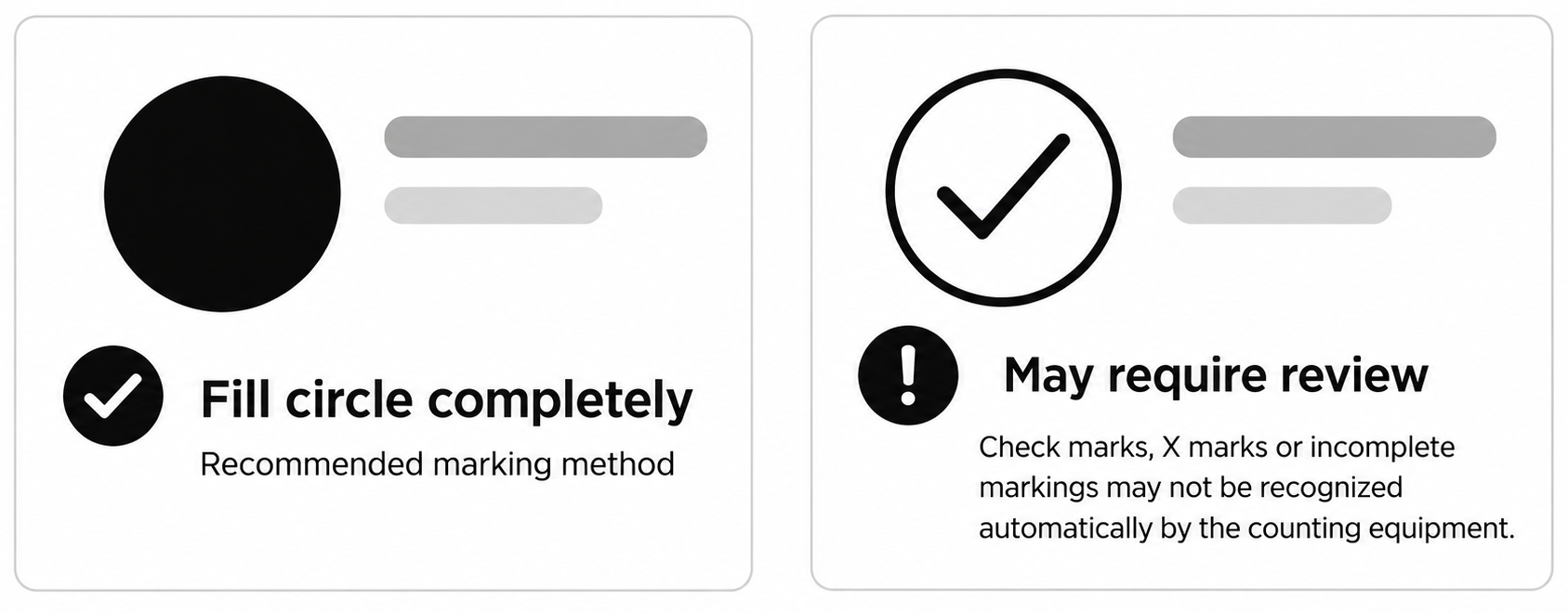
Fill in the entire voting circle rather than relying on a check mark, X or mark outside the circle.

Clear, complete markings help the voting equipment recognize and record your intended selections.

Election officials can demonstrate how to use the voting equipment and explain how to complete your ballot.


ILLUSTRATIVE EXAMPLE


Image credit: AI-generated illustration created using OpenAI's ChatGPT for the District of Sooke (2026).


Selecting more candidates than the maximum permitted is called an overvote.

For example, if six Councillor positions are available and you select seven candidates, the votes for that contest cannot be counted as valid.

An overvote in one contest does not necessarily invalidate valid votes in other contests on the same ballot.

To avoid this, check the maximum number of selections permitted before submitting your ballot.

If you make a mistake while marking your ballot, ask an election official for assistance before submitting it.

For in-person voting, you may request a replacement ballot. The original ballot will be marked as spoiled and will not be counted.

If you are voting by mail, contact the District's election office for instructions about replacing a spoiled ballot.

A voting circle that is only partially filled in may not be recognized by automated vote-counting equipment.

However, this does not automatically mean the intended vote is invalid.

Under the Local Government Act, election officials must consider whether a mark clearly indicates the voter's intention, subject to the legal rules for accepting votes and rejecting ballots.

During the official election results verification process, ballots may be reviewed manually to determine voter intent.

The best way to help ensure your vote is accurately recorded is to fill in the voting circle completely.

Yes. Ballot secrecy is an important part of the election process.

Electors mark their ballots privately, and procedures are in place to protect the secrecy of their selections.

How Are Votes Counted?

The counting and verification of ballots follow procedures established under provincial legislation and the District's election procedures.

These procedures help ensure that ballots are accounted for, votes are accurately recorded and official results reflect the valid votes cast.

Sooke uses an automated vote-counting system for its municipal elections.

Electors mark paper ballots, which are then scanned by vote-counting equipment.

The equipment records recognizable selections and produces a record of the votes counted.

The original paper ballots are retained and secured as part of the election record, allowing election officials to review ballots when required.

The voting equipment assists with counting, but the election process also includes human oversight, ballot reconciliation and verification.

Once voting closes, election officials complete a series of procedures to account for ballots and determine the election results.

These include:

  1. Counting votes: Votes cast at the applicable voting opportunities are counted according to established procedures.
  2. Preparing ballot accounts: Election officials document the ballots and votes recorded, including the required accounting information.
  3. Releasing preliminary results: The Chief Election Officer may announce preliminary results before the final verification process is complete.
  4. Verifying results: Ballot accounts are reviewed, and the Chief Election Officer may examine or recount ballots where necessary as a part of the final determination process.
  5. Declaring official results: The Chief Election Officer determines and declares the official results in accordance with provincial legislation.

Candidates and their authorized representatives have defined opportunities to observe election proceedings, including certain counting and verification activities.

Preliminary results are the initial results released after voting closes. They provide early information about the outcome of the election but are subject to verification.

Official results are declared by the Chief Election Officer following the required determination process.

Official results may differ slightly from preliminary results if the verification process identifies corrections to ballot accounts or votes that require further consideration.

Any changes must be made in accordance with the applicable legislation.

A recount may be undertaken when the Chief Election Officer determines that further examination of ballots is warranted to verify the official results.

Reasons may include a close margin between candidates, discrepancies identified during ballot reconciliation or ballot markings that require additional consideration.

A recount does not necessarily mean the original counting equipment malfunctioned or that the election was conducted incorrectly.

The Chief Election Officer has statutory authority to review or recount all or some ballots during the determination of official results.

A separate process, known as a judicial recount, may be conducted through the Provincial Court under circumstances established in the Local Government Act.

An Example from Sooke's 2026 Election

Following the October 17, 2026 General Local Election, the District conducted a full manual recount as part of the official results verification process.

During the review, election officials identified five ballots containing a total of six selections that had not been recognized by the automated counting equipment.

In each case, the voter intent was clear, but the corresponding voting circle had not been sufficiently filled in for the selection to be recognized automatically.

The review confirmed that the discrepancy resulted from how the ballots were marked, not from an equipment malfunction.

The additional votes were included in the official results. The recount did not change which candidates were elected.

This example demonstrates why complete ballot markings are important and how the post-election verification process provides an additional safeguard.

Read the official 2026 election recount announcement.

Understanding Election Results

Election results provide information about the candidates elected, the votes received and overall voter participation.

However, different figures in an election report measure different things.

In municipal elections, voters may select more than one candidate for Councillor.

For example, if a voter selects six Councillor candidates, that voter has cast one ballot containing six separate candidate selections.

As a result, the total number of votes received by all Councillor candidates can be much greater than the total number of people who voted.

This is expected and does not mean that people voted more than once.

Electors may choose to vote in some contests or questions while leaving others blank.

For example, an elector may vote for Mayor and Councillors but choose not to answer a separate opinion question.

Therefore, the number of responses to a particular question may be lower than the total number of electors who participated in the election.

Voter turnout measures participation in an election.

It is generally expressed as the number of electors who voted compared with the number of eligible electors, shown as a percentage.

For example, if 4,000 people voted from an estimated 10,000 eligible electors, voter turnout would be approximately 40%.

Turnout figures based on estimated eligible voters may differ from figures calculated using other registration or population data.

The District maintains an Election Results Archive documenting municipal election results since Sooke's incorporation in 1999.

This includes elected Mayors and Councillors, municipal by-elections and historical questions presented to voters.

Explore the Election Results Archive.

Understanding Ballot Questions

In addition to choosing elected representatives, voters may occasionally be asked to provide their opinion or approval on a particular municipal matter.

The purpose and legal effect of a ballot question depend on the type of voting being conducted. 

A plebiscite, sometimes called a non-binding opinion question, allows voters to express their views on a particular matter.

The results help Council understand community opinion and may inform further consideration of a proposal.

A non-binding plebiscite does not, on its own, legally require Council to proceed with a proposal or authorize a particular expenditure.

Council must still consider applicable financial, legislative and other requirements before making decisions.

Assent voting, commonly referred to as a referendum, is a formal process used to obtain elector approval for certain matters as required by provincial legislation.

Unlike a non-binding plebiscite, assent voting has a specific legal purpose and can satisfy a statutory requirement for elector approval.

A majority of valid votes in favour is generally required to obtain elector assent.

Further Council decisions or statutory approvals may still be necessary, depending on the proposal.

Yes. Sooke voters have been asked questions about municipal matters at different points in the community's history.

During the 2026 General Local Election, voters were asked a non-binding opinion question about whether the District should consider borrowing up to $5 million toward the proposed Sooke Gathering Place intergenerational centre.

A majority of voters who answered the question selected YES. However, the result did not authorize borrowing, approve construction or commit District-owned land to the project.

Learn more about the 2026 Sooke Gathering Place plebiscite results and next steps.

Historical ballot questions, including those from previous elections, are also recorded in the District's Election Results Archive.

Running for Mayor or Council

Local elections also provide an opportunity for eligible individuals to serve their community as elected representatives.

Under provincial legislation, candidates for municipal office must generally:

  • Be at least 18 years of age on General Voting Day.
  • Be Canadian citizens.
  • Have been residents of British Columbia for at least six months before the relevant nomination date.
  • Not be disqualified from seeking or holding elected office under applicable legislation.

Candidates for municipal Council do not have to live within the municipality where they are seeking election, although they must meet the applicable eligibility and nomination requirements.

Prospective candidates must submit nomination documents to the Chief Election Officer during the official nomination period.

This includes obtaining nominations from qualified electors within the municipality and providing the required forms and disclosures.

The District publishes candidate nomination packages, instructions and applicable deadlines before each general local election or by-election.

Candidates are also responsible for understanding and complying with campaign financing and election advertising requirements administered by Elections BC.

Learn about local election requirements for candidates — Province of B.C.

Explore campaign financing resources — Elections BC.

During an election, the District publishes required candidate information and official election notices.

Candidates may also communicate directly with voters through their own campaign materials, public events and other channels.

Community organizations may host all-candidates meetings, providing an opportunity for residents to hear from candidates and learn about their perspectives.

The District does not endorse candidates or promote individual election campaigns.

Who Administers Local Elections?

Local elections in British Columbia are administered through a shared framework involving local governments, Elections BC and the Province.

The District administers municipal elections in accordance with provincial legislation and its election procedures.

Its responsibilities include appointing a Chief Election Officer, administering candidate nominations, organizing voting opportunities, counting votes and declaring official results.

Elections BC administers campaign financing, election advertising and elector organization registration rules under the Local Elections Campaign Financing Act.

Elections BC does not administer municipal voting locations, candidate nominations or local vote counting.

The Province establishes the legislative framework for local elections, including voter and candidate eligibility, election procedures and the powers and responsibilities of local governments.

School trustee elections are also governed by applicable education legislation.

Additional Resources

For more information about local elections, voting requirements and election administration, visit:

Questions About Local Elections?

For questions about municipal elections, voting procedures or election records, please contact:

District of Sooke — Elections 

2205 Otter Point Road
Sooke, BC V9Z 1J2

Email: elections@sooke.ca
Phone: 250-642-1634

Detailed information about future voting opportunities, nomination requirements, registration procedures and election deadlines will be published through the District's Elections page as the next election approaches.

Contact Us

District of Sooke
2205 Otter Point Road
Sooke, BC V9Z 1J2 


Hours: Mon-Fri 8:30am – 4:30pm
Phone: 250-642-1634

Sign up to our Newsletter

Stay up to date on the District’s activities, events, programs and operations by subscribing to our eNewsletters.